Why it's the Polymath's moment
This essay will contain some unsubstantiated claims. And that is by design.
This is an essay about my Convictions – or unproven hypotheses – based on a combination of facts, intuition based on lived experience, and predictions.
I know I could be wrong, but I’m betting that I’m not.
I’m making my thinking explicit to become aware of risky Convictions and hold myself accountable.
TL;DR
My Conviction is: historically, cross-pollination of ideas have led to Breakthroughs. Polymaths — who have knowledge of different domains — are indispensable at a time of Breakthroughs. They can be involved in causing and subsequently harnessing Breakthroughs to make Awesome Things.
We are currently undergoing a Breakthrough —Generative AI is a platform shift with its full utility yet to realised. We can create even more Awesome Things if we cross-pollinate ideas from different disciplines. By applying their knowledge, polymaths can bring ideas from different domains making the polymath crucial to create Awesome Things.
Consequently and significantly, this particular Breakthrough actually makes it easier than ever for anyone to become a polymath. All you need is basic aptitude, growth mindset, and discipline.
But trying to be polymath carries risks of indulging in sloppy dilettantism or confusing limited knowledge for expertise. Both are dangerous tendencies that can lead to bad decisions or influence.
I share simple but serious methods to counter these tendencies.
Cross-pollination of ideas have led to Breakthroughs
Historically, Breakthroughs have emerged from a cross-pollination of ideas across disciplines. These ideas could either have been harbored by 1 person; or generated through interactions between team members. Either way, cross-pollination across domains requires understanding different mental models for attacking the same problem.
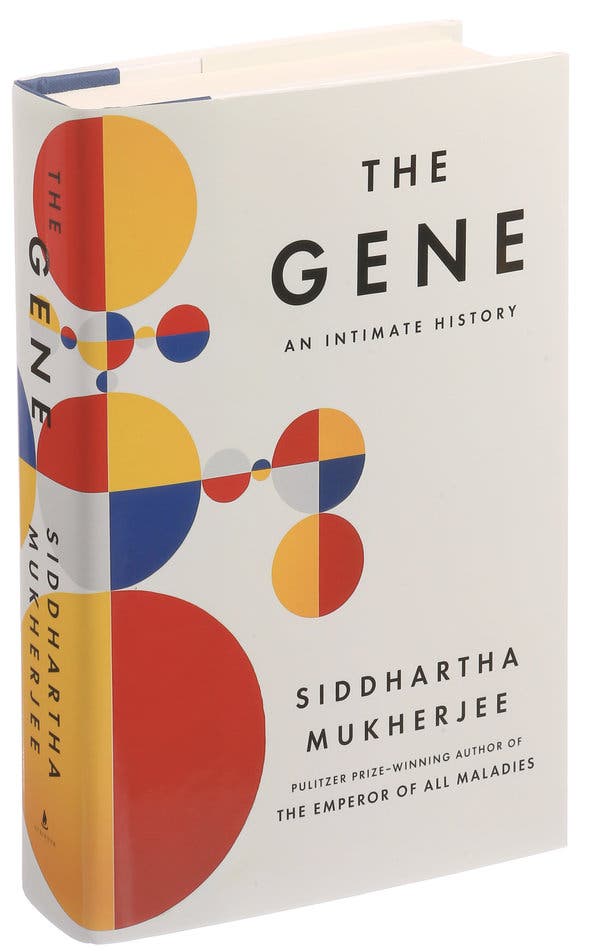
A fun example: a physicist applied crystallography theories to deduce the double-helix structure of the DNA. Dr Siddhartha Mukherjee in his wonderful book, Gene , describes how Crick, part of a broader wave of physicists entering biology post World War 2, brought mathematical rigour, modelling, and daring optimism to discover the double-helix structure of DNA1. Beyond this specific contribution, Dr Mukherjee generalizes the impact of physicists and chemists transforming biology by transplanting techniques.
Atomic physicists were particularly interested in biology; it was the unexplored frontier of scientific inquiry. Having reduced matter to its fundamental units, they sought to reduce life to similar material units. The ethos of atomic physics —the relentless drive to find irreducible particles, universal mechanisms, and systematic explanations—would soon permeate biology and drive the discipline toward new methods and new questions. The reverberations of this ethos would be felt for decades to come: as physicists and chemists drifted toward biology, they attempted to understand living beings in chemical and physical terms —through molecules, forces, structures, actions, and reactions. In time, these emigres to the new continent would redraw its maps. 2
In fact, Bell Labs —dubbed as the Idea Factory for giving us Awesome Things like transistors, lasers, and satellite communication systems — intuited this principle so much that they deliberately designed labs to promote organic interactions between mathematicians, chemists, and physicists.
“ All buildings have been connected so as to avoid fixed geographical delineation between departments to encourage free interchange and close contact among them.” 3
“ By intention, everyone would be in one another’s way. Members of the technical staff would often have both laboratories and small offices —but these might be in different corridors, therefore making it necessary to walk between the two, and all but assuring a chance encounter or two with a colleague during the commute….the long corridor for the wing that would house many of the physics researchers was intentionally made to be seven hundred feet in length…Travelling its length without encountering a number of acquaintances, problems, diversions, and ideas would be almost impossible. ”
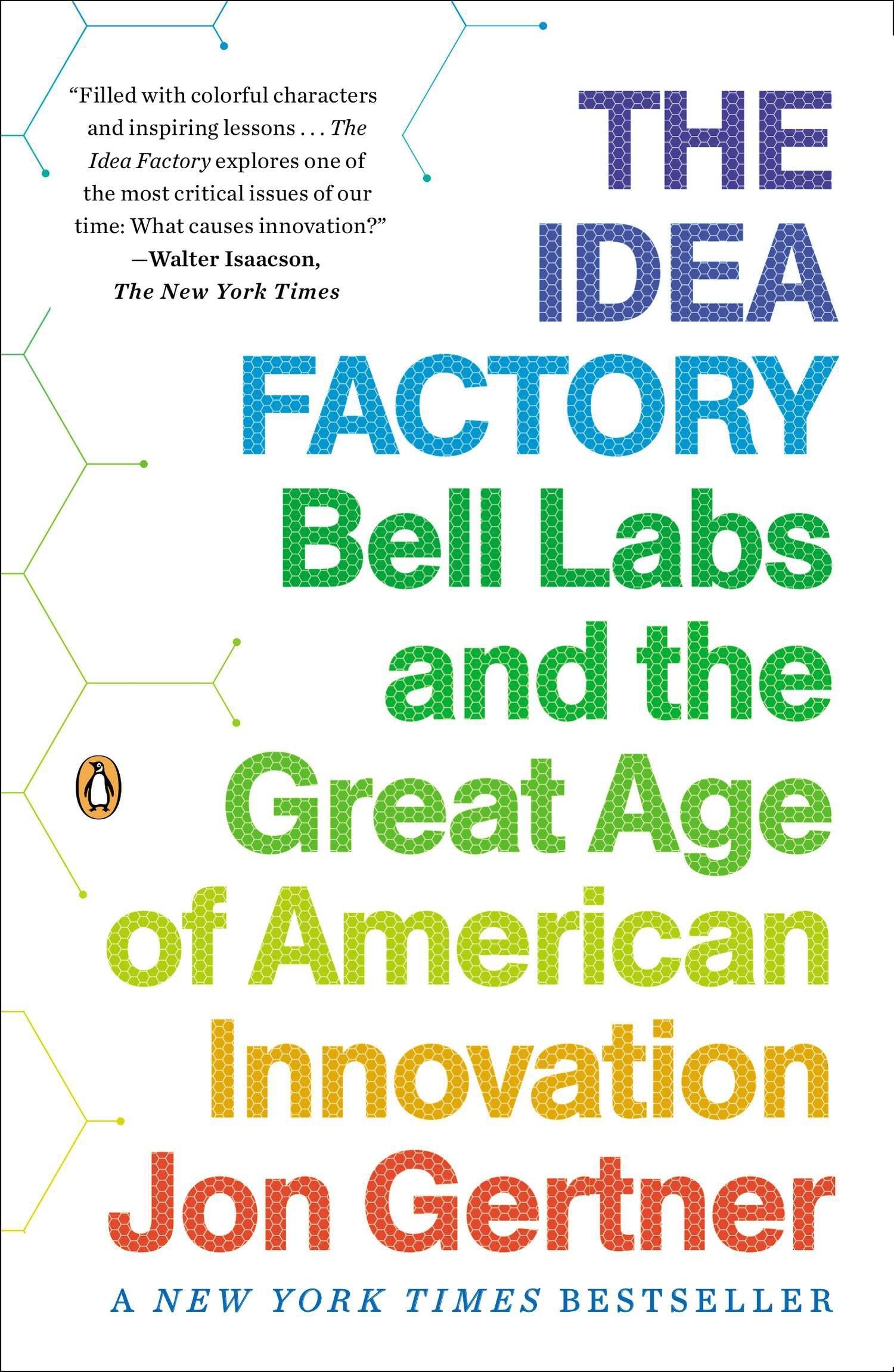
The physical infrastructure of the Idea Factory was deliberately designed such that a scientist walking to the cafeteria was like a “ magnet rolling past iron filings” of ideas, problems, and people4.
Architecting spaces to make inter-disciplinary interaction more likely underscored the importance of cross-pollinating ideas and the role it played in creating a system of consistent innovation.
Breakthroughs bring uncertainty and ambiguity
Once a Breakthrough has emerged, it creates ambiguity and uncertainty. New platform shifts imply new ways of solving problems or new problems leading to more Awesome Things. But first this creates ambiguity and uncertainty, bringing with a Breakthrough several questions:
-
what are its capabilities and limits
-
what are risks of using it
-
how can we actually get value from its capabilities
-
what are some new problems that we can solve with this
-
what are emergent problems that it will bring
All of these problems require an interdisciplinary approach to solving. If we approached these problems from first principles, we might hit different domains of knowledge to curate an answer.
Different problems might also demand investigation at different depths and breadths. For example: let’s say we’re exploring the application of LLM to a financial institution in the context of convincing its conservative leader to make a $1M purchase. We need to unpack this problem statement at different depths and domains:
-
what’s the conservative leader’s key blocking concern (Psychology, Business)
-
how significant is $1M to the business (Business, Economics)
-
what is the company’s most significant pain point (Business, Finance, Operations)
-
what are LLM’s current capabilities? (Technical)
-
how can we reduce the cost of delivering this LLM solution (Technical, Finance)
Having siloed expertise is just one domain might not be enough. People solving new, amorphous problems have to understand the world through each other’s mental models. Knowledge spills across the maps we try to draw of it.
Polymathy enables the cross-pollination of ideas
The best approach to solving this problem is not a siloed approach to thinking; instead it’s best served by an interdisciplinary, collaborative approach where multiple heads tinker with a question. Each might probe a question to a different depth within a domain. But approaching a problem statement from first principles —instead of a domain-focused statement — is probably more effective.
I’ve never worked on a Nobel Prize–winning breakthrough. But I did enjoy an interdisciplinary project at a startup: scaling and automating fraud detection. We began with financial regulations, translated broad guidelines into statistical rules, and then drafted user stories that dictated actions. What I loved most was the back-and-forth of borrowing mental models from law, statistics, and product design, and watching them meld together. From understanding system design constraints for synchronous vs asynchronous monitoring or design principles for presenting information effectively, I enjoyed the domain-diving.
Current Breakthrough makes it easier than ever to be a polymath
LLM in particular has made learning ridiculously personalized and easy. Anyone can understand a broad range of things faster and more effectively. In fact, even if you’re not technical, the barrier to learning has fallen even further, and going deep has become less daunting. Just open ChatGPT or NotebookLM to plug in whatever question you might have.
That’s why I oppose arguments that ask people to focus on one end of the stack, ignore technicals or show disdain for reading research papers. I get that formal logic might not be as accessible to everyone. I recall this one time when we were trying to teach fellow law students to code at a workshop, we gave them an exercise of finding the perfect square to introduce loop & lists. A few genuinely freaked out because it was math. That type of fear needs a lot more unpacking and mindset a shift (I recommend Barbara Oakley’s https://www.coursera.org/learn/math-click). Barring that sort of fear, we now have abundance of resources for the motivated learner.
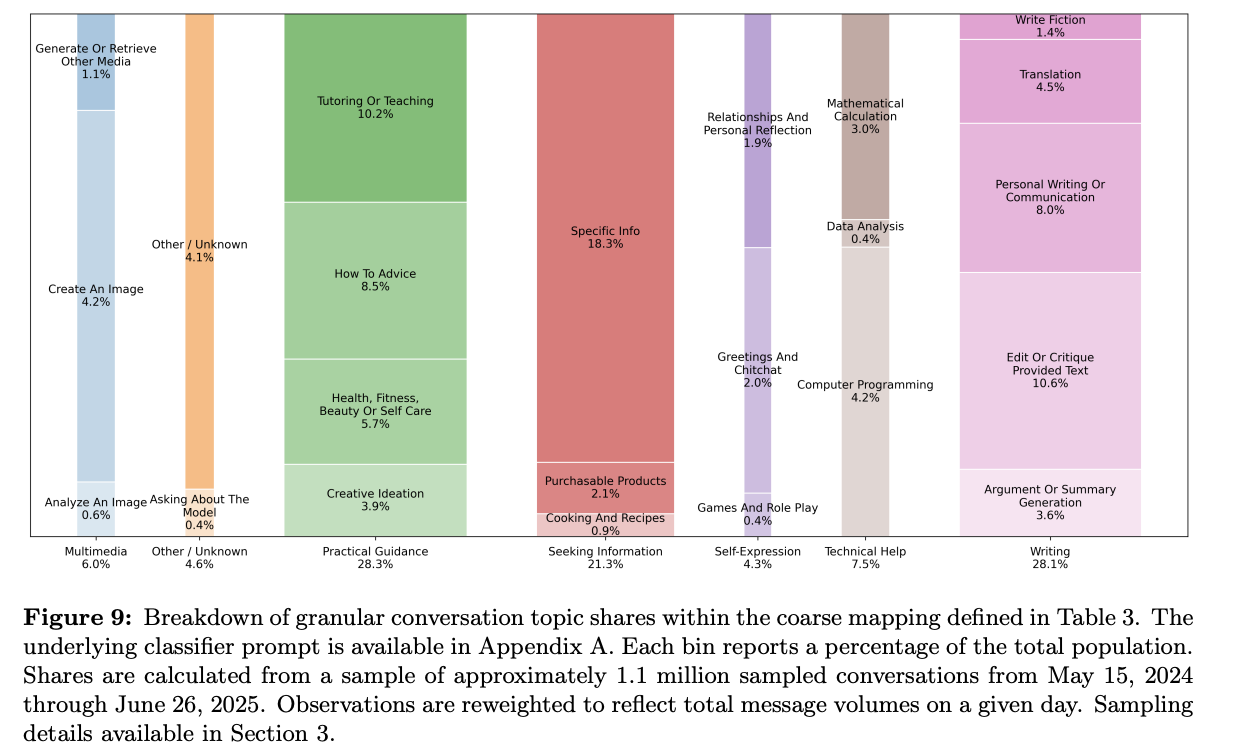
In fact, a recently released paper by Open AI in the National Bureau of Economic Research5, shows how self-learning is already a trend. From a sample of 1.1M conversations, 10% were tutoring or teaching related.
“ About 10% of all messages are requests for tutoring or teaching, suggesting that education is a key use case for ChatGPT. ”
This is based on a taxonomy developed by Open AI. But the actual process of self-learning and mastery touches on categories beyond tutoring and teaching: it could arguably involve editing or critiquing as part of the process of learning, or say seeking technical help at the point of applying programming knowledge.
All of this is to say that there is a powerful and FREE consumer product that’s as good as having a personal tutor for multiple knowledge domains.
Beware the Dilettante and Dunning-Kruger
Dilettantism =/= polymathy
Not everyone who consumes information is necessarily a polymath. Pursuing knowledge with the only intention to posture or signal expertise is dangerous. Having a learner mindset can easily lapse into dilettantism. Learning new domains superficially, just enough to sound smart is…lame. Name-dropping concepts to impress at a dinner party or to schmooze up to a boss at a weekly’s might give a dopamine kick — but it’s just as unsustainable as it is superficial. There’s no ~value~ to this limited knowledge. And sooner or later, people can tell when you’re full of s**t.
Learning anything new requires personalized effort. We have to understand new content on our ownt terms; fit new knowledge into existing mental models or revise our models altogether. This type of mental back-and-forth demands a level of effort and commitment that the dilettante does not bring.
To illustrate: if you’re learning new concepts in maths, it’s not enough to just consume YouTube videos explaining the concepts or solutions. You have to work through the problem-sets. If you’re learning philosophy, it’s not enough to consume an article about a philosopher’s position. You have to work through the arguments, test the limits of the premises, follow the conclusions, think through the implications, and critically evaluate it.
Without engaging with the knowledge, it is impossible to really know.
Ignoring limits and intellectual sloppiness
Dilettantism is about the intent of how deeply you want to understand something. But there’s a more dangerous risk: the fallacy of unintentionally believing you know more than you actually do.

There’s a risk of overestimating one’s own competence owing to the Dunning-Kruger cognitive bias , and relying on that limited knowledge to make decisions. But if you’re aware that your interest in a topic is genuinely recreational - that’s fine. What you want to avoid is confusing superficial knowledge for foundational understanding and amateurism for authority.
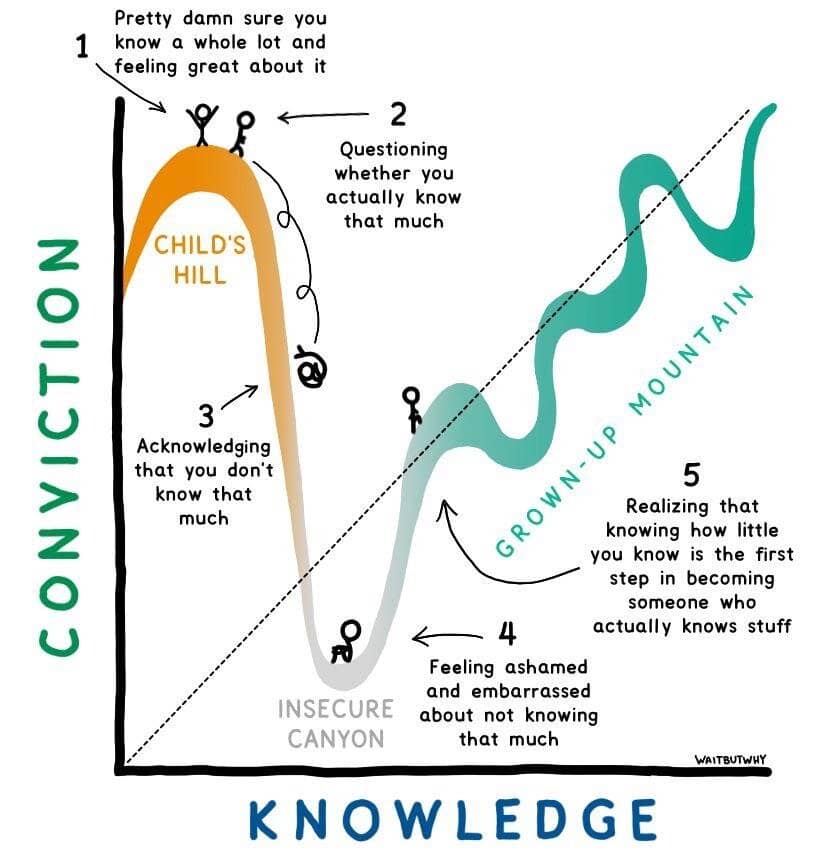
Source: 100% Tim Urban’s art fromWait but Why
This tendency is especially pronounced in ambiguous spaces. It is difficult to know what you don’t know when knowledge itself changes so fast. Consider the advancements in LLMs. So much is changing so regularly67. In this context, intellecutal integrity demands that you remain conscious of the limits of your knowledge: that you might not know a lot of things and that’s okay, but at least know that. To put it simply, be —or cultivate the habit of becoming— aware of the limits of your knowledge.
A framework to manage the risks
Of course, learning is an ongoing process. Especially, if you’re self-learning or otherwise lack formal education, it is not straightforward to mark sufficient expertise milestones.
To that end, the test of a polymath, distinguished from a dilletante while avoiding Dunning-Kruger complacency is this: whether they have sufficient mastery over sufficient domains to apply it productively. Productive application could mean a new product or a new process: a new thing or a new way of doing something.
What’s important here is the consistent effort and discipline to apply knowledge. Essentially, you need some level of intellectual awareness and honesty.
Any one of the three will force you to understand things at a greater depth than passively absorbing a YouTube video or reading notes might give.
Publicity : Scale your understanding by sharing your understanding. You’re putting in the reps to think methodically, express coherently, and invite discourse.
Benchmarks : Standardized tests are a decent milestone. The syllabus is structured and compels you to read and apply. Not all standardized tests are the same though - some can be “gamed” through memorization. But holding yourself to meet this bar in itself encourages a more disciplined and deeper level of preparation. A friend — trained in CS — but interesting in a whole host of other topics systematically took entrance tests from other domains like LSAT for law to benchmark herself.
Functionality : Apply what you learnt in a way that brings value to someone. This isn’t just sharing your notes in public. It’s explaining it in a way that’s understood. Or building something new that people actually find useful. Some examples:
-
Application of philosophy to a modern problem
-
Applying a technique in physics to some other domain
-
Applying software engineering principles by building an app
Threshold for dilettantism is a subjective sliding scale. For some, nothing less than a patent is enough; for others launching a product is enough evidence of sufficient knowledge; to yet others, sharing study notes online that get downloaded is evidence of mastery. Either way, the aspiration should be put knowledge to the test: in public, in practice, or in impact – to hold yourself accountable.
In conclusion
The current platform shift provides such an exciting opportunity to reimagine what brings value to users and to redesign products that we will use for the next decade. Sometimes. It’s the unexpected connections across unrelated domains that spark creative solutions. Knowing different domains increases the chances of finding such connections.
We should go deep into domains as far as we can. But we must remain cognizant of our limits so that knowledge doesn’t become hubris. We should aim for a more sophisticated understanding of the world and of our own understanding.
I’m saying this as much to myself as to anyone else. Essays like this are a fun way of applying ideas I’ve picked up along the way and pushing my own thinking further each time.
-
From Rosalind Franklin’s data, as Dr Siddhartha Mukherjee takes pain to emphasize in his book ↩
-
Dr Siddhartha Mukherjee, “ Gene ”; https://www.goodreads.com/book/show/27276428-the-gene ↩
-
O.E. Buckley to Dr. Jewett, May 17 1938. AT&T Archives ↩
-
Jon Gertner, “ The Idea Factory: Bell Labs and the Great Age of American Innovation ”; https://www.goodreads.com/en/book/show/11797471-the-idea-factory ↩
-
https://www.nber.org/system/files/working_papers/w34255/w34255.pdf ↩
-
Stanford University published statistics on trends in AI research and model development: https://hai.stanford.edu/ai-index/2025-ai-index-report/research-and-development; ↩
-
From an economics perspective, Mark Meeker quantifies this rapid change in her report https://www.bondcap.com/report/pdf/Trends_Artificial_Intelligence.pdf ↩